- JooBee's Newsletter
- Posts
- #66 JooBee's newsletter
#66 JooBee's newsletter

JooBee Yeow
April 30, 2026
TL;DR
👣 When someone is hired above you, should you stay or leave?
🙋🏻♀️ How I built my HR career by knowing exactly when to leave
🎧 Listen to the newsletter here
This newsletter edition is brought to you by Screenloop 💛
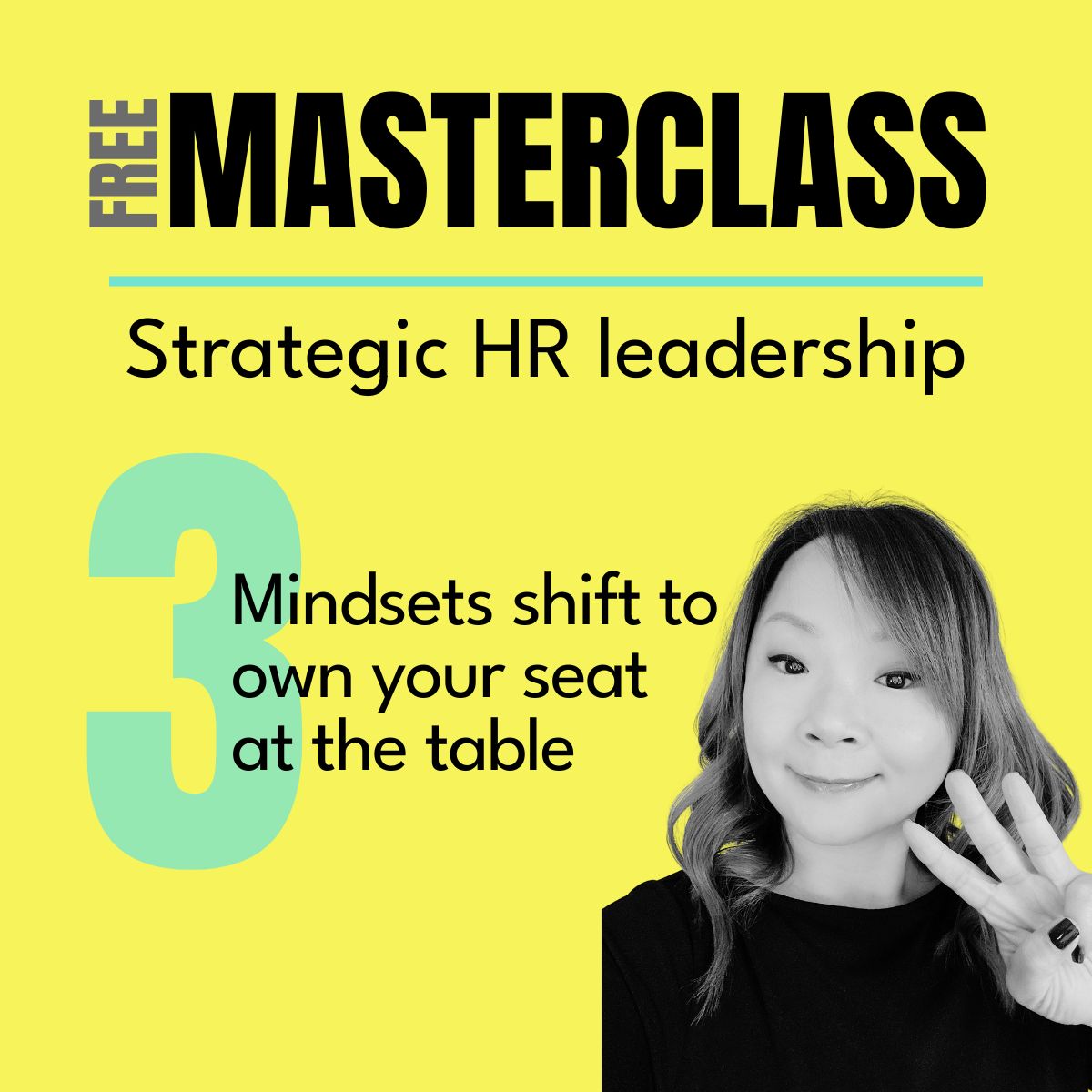 | Strategic HR Masterclass with JooBeeIn this FREE masterclass, I’ll share 3 mindset shifts that helped me lead more strategically, so you can apply them to grow your confidence, sharpen your thinking and drive business impact. |
Question: JooBee, I've been Head of People since day one. We just raised our Series B and the CEO wants to hire a VP People above me. I know it's the right call for the business. But I'd be lying if I said it didn't sting. How do I know whether I should stay or whether this is the signal to move on?
When someone is hired above you, should you stay or leave?
We know this moment is coming before almost anyone else in the business does. We sit in the leadership meetings. We build the org design. We hire the CTO above the Head of Engineering, or the VP of Finance above the Head of Finance.
But knowing it is coming does not make it hurt any less when it is our turn.
The feeling that you helped build this company before the product worked, before the revenue came in, before anyone knew your start-up existed, and now someone else gets to lead the people function you built. That stings. And it's okay to say so.
In this newsletter, I want to focus on a specific scenario: the one where the role has genuinely outgrown your experience and capabilities. Not where you've been overlooked unfairly. But where, if we're honest with ourselves, the business has grown into something that now requires a different set of skills than the ones you were hired to bring.
The 2 career inflection points in start-ups
In my experience coaching HR leaders at scaling start-ups, this typically happens at 2 moments.
1️⃣ Between the Start and Build stages. The Start stage is about product-market fit, where everyone does everything, boundaries are loose, and experimentation is the job. The people who thrive here love the ambiguity. They're energised by experimentation, by wearing ten hats, by the sheer breadth of problems they're solving on any given Tuesday.
The Build stage is different. The business now needs a repeatable go-to-market motion. That requires depth, not breadth. Structure. Specialisation. Optimised systems. The profile of the person the business needs has shifted.
2️⃣ Between the Build and Scale stages. The Scale stage comes when the business is expanding into new markets, diversifying its product, acquiring other businesses or preparing for exit. The HR leader profile shifts again: from someone extraordinary at building structure, to someone who can navigate a fundamentally different level of complexity.
Start, Build, and Scale are not small step changes. They are fundamentally different businesses, with fundamentally different skill requirements.
The 4 career IKIGAI questions
When I'm coaching an HR leader at this inflection point, the first thing I do is ask them to zoom out. It is very easy to make a short-term decision — look at current situations and decide based on how it feels right now.
Remember, this is one small moment in a much longer career.
So, before you answer the questions below, hold it in that wider context.
📊 What does the business need?
A Start-stage company needs breadth. Build needs depth. Scale needs complexity. Knowing what the business needs at the next stage is important. But not as a signal to immediately start developing ourselves to move with it. The harder question is whether you want to work in that environment.
And that's what the next 3 questions are really asking.
💜 What do you love and what are you naturally wired for?
This is not just about skills. It's about personality and energy. Do you love the speed and chaos of zero-to-one? Or do you come alive when you're building systems that work at scale? There is no wrong answer. But there is a right one for you. Don’t let short-term title or prestige distract you from choosing what energises you every day, because it will cost you more than you expect.
⚖️ Breadth or depth: What do you want to get good at?
Do you want to grow the breadth of your experience — to have been the Head of People who took a company through Start, Build, and Scale to exit? That's a rare and powerful career story.
Or do you want to grow the depth — to become the person who specialises in the Build stage, who can do it faster and better than anyone else? That's a different kind of rare.
Both are valuable career paths. But they come with very different trade-offs. For breadth, you need to be prepared to learn from the person hired above you and bootstrap your own growth in the process. For depth, you need to be prepared to leave the company you built and go back to do it all over again somewhere else.
💰 What will you be paid for (what’s the trade-off)?
We know better than anyone what the market pays. If we choose breadth, there is an opportunity to grow our earnings because the role becomes more complex, and the compensation follows. If we choose depth, we are essentially doing the same job with greater efficiency, which means our earnings will sit within the band for the stage of company we choose to specialise in.
All 4 questions come from the Japanese concept of Ikigai: 'a reason to live' or 'a reason to jump out of bed in the morning.'
Our careers take up almost a third of our lives. We spend so much of it helping others make better decisions about theirs. We owe ourselves the same rigour.
Career strategy is also a choice
When you’re standing at this inflection point, and someone has been hired above you, it stings. But it also gives you something important: a moment to make a deliberate choice.
As you decide whether to stay, what to negotiate, or what your next move looks like, there is only one question that matters:
In the bigger picture of my whole career, what move serves the career I am building?
Strategy is about making a choice that serves your long-term goal.

How I built my HR career by knowing exactly when to leave
Let me bring the 4 questions above to life by sharing with you my own career Ikigai.
I love the Build stage. As a former systems engineer, it is the problem I am wired to solve; building organisations with structure, systems, and ways of working that scale. I am good at it, and it brings me joy. And it pays at a level I am comfortable with.
I am not one for “big houses, big cars, and big rings” (Eeks, the BTS lyric escaped. It happens when I'm left unsupervised 😅). What I want is security, my mortgage paid, and enough flights home to see my family in Malaysia.
So across my start-up career, the choice has always been depth in the Build stage. And I want to share what I chose to do each time I reached an inflection point between Build and Scale.
I was good at building systems, but not at driving change
My background was in OD (the ‘back-end’ of HR) where I built people experience products. But I kept hitting the same roadblock: adoption. So, I made a deliberate move into people partnering (the “front-end”) to understand what employees and leaders were actually dealing with day-to-day, and how to increase adoption.
I learnt to let go of my ego of “this is the best thing I’ve built” and replace it with genuine empathy for busy employees and leaders. I also learnt how to influence and drive change at different levels of the organisation.
I still remember my first month. I askedmy CPeO: "What do you want me to achieve in two years?"
He said: "Why two?"
I said: "Because I'm leaving in two years."
He was curious rather than offended, so I told him: “I want to increase adoption and grow my influencing skills. Once I have that, I want to go back and build again, but do it better.”
💡 Takeaway: Just to be clear, telling your manager you want to leave in two years is not the key takeaway here. Not every manager appreciates that level of honesty😅. The key is being clear on what you want to grow over the next two years, then making deliberate choices to gain those skills and experiences.
I wanted to build an HR team with product-led principles
Two years later, I left with a new skill and a new idea. I wanted to test building an HR team with product principles; the way the team is structured, the way it thinks, the way it works.
With that goal in mind, I joined a company I believed would let me do exactly that. Three months in, I realised I was wrong. It was a genuinely exciting company. The highest talent density I had ever worked with. Backed with £80M at Series B. We had the budget. But the founder proved difficult to work with in the way I needed. So I was at a crossroad:
Do I stay, knowing my development would be delayed?
Or do I leave, knowing the thing I wanted to test might never happen there?
So I left after six months. This time, I joined a company that truly gave me the space to build a product-led HR team. (You can read about how I did that in Season 2 of my blog: click here).
💡 Takeaway: When you have clarity on your career goal, it becomes easier to see whether an environment will help you grow into it. And if the environment does not allow the work to happen, your next step becomes much clearer.
I wanted to do it all over again, but faster
By year 2, the foundation had been built, and the business was heading into Scale. I was ready to leave again. But this time, I had a different goal: I wanted to help start-ups move through the Build stage faster, with fewer roadbumps, by building the right foundations even quicker.
During contract negotiations for the next role, I told my founder: "I'll leave when we hit around 400 people. And I'll help you hire my backfill."
He asked why.
I said: "It's a different problem the business will be solving at that stage, and I don't have those skills."
He said: "You never know. You could grow into it."
I said: "I don't want to."
He was taken aback. So I explained: “I love building to scale. I do not love the complexity of scaling to exit. I wanted to go back and do it again. That is the skill I wanted to keep sharpening.”
When we started to hit 400 people, and the business started acquiring other companies, the signs were there. So I kicked off the backfill hiring process myself. Here’s the LinkedIn outreach message I sent to our ideal next CPeOs:

💡 Takeaway: When you know the career you want to build, you feel more in control of your choices. You also make yourself more valuable because you are choosing the work you are genuinely good at, enjoy doing, and want to keep getting better at.
The goal is long-term career clarity
I want to be open about something. Leaving deliberately is a tactic, not the goal. The goal is to grow your career with intention. The choices you make to get there could look very different to mine.
The reality right now is different; the job market is harder, AI is reshaping HR, and every move feels riskier. Which is exactly why clarity on the career you are building is not a luxury. It is what makes you harder to replace and more valuable in a market moving faster than any of us expected.
At every inflection point, there is an opportunity to get clear on that bigger picture. In the current climate, that clarity is your most important career asset.
Step up from HR Leader to Business Leader
Ready to influence strategically, drive business impact and make HR indispensable?
Here are 3 ways I can help:
 |  |  |

Reply