- JooBee's Newsletter
- Posts
- #64 JooBee's newsletter
#64 JooBee's newsletter

JooBee Yeow
April 02, 2026
TL;DR
👀 HR impact doesn't speak for itself: Here's how to make it visible
🔗 Linking HR work to business impact is simpler than you think
🎧 Listen to the newsletter here
This newsletter edition is brought to you by Zelt 💛
 | Exclusive invite to Business IntelAn exclusive invite to 2 x Business Intel sessions (a STEP UP Boardroom members-only event). In these sessions, we bring in Founders, VCs/PEs, and CxOs across GTM, product and tech — to help HR leaders think strategically and show up with commercial confidence at the exec table. |

Question: I get that the business cares about revenue, EBITDA, NRR, etc. But when I say an HR initiative will move those numbers, it feels like a stretch… even to me. How do I actually connect what HR does to the metrics the business cares about?
HR impact doesn't speak for itself: Here's how to make it visible
I agree with Thomas. If an HR Leader says: “Restructuring the CS and Product teams will increase revenue….,” it almost sounds like we’re asking the business to just take a leap of faith (and we’re not in that kind of business 😅).
That’s a hypothesis with a VEEEERY long jump in the causal link between what we do and the business outcome. When that chain is invisible, stakeholders are left choosing between belief and scepticism….and most will go with scepticism. No surprise there.
Start with the business bet, not the HR rationale
Before HR can connect its work to commercial outcomes, we must understand something most HR leaders miss: how the business has decided to grow.
Say your business has set a target to grow revenue by 40% this year. The leadership team has made a bet: 50% of that growth will come from existing customers, through a new product you're launching into your current customer base.
From that, your business lays out some assumptions. For example, it may forecast that a certain percentage of existing customers will buy the new product and that the customers will do so if they can experience value quickly and adopt it easily.
These assumptions translate to specific lead measures. These are the metrics that (if they move) tell you the strategy is most likely working before the revenue lands. In this example, they might be:
Upsell rate: What % of existing customers buy the new product
TTV (Time to Value): How quickly new customers get to their first meaningful outcome
CES (Customer Effort Score): How easy the experience is, which drives retention and word of mouth
These 3 metrics are the business's hypothesis of how it gets to 50% of its revenue growth. They are the chosen levers — and the first step in connecting HR’s impact to the business.
Because if we can influence these levers, we’re no longer guessing at revenue. We’re working on a real part of the chain that gets there.
Revenue is the outcome. The system in between is where HR makes an impact
Revenue growth is a lag outcome. It sits at the end of a chain of:
HR work ➡️ change systems (process/structure/capability) ➡️ change in individual & org execution ➡️ dept/business outcome (lead) ➡️ business outcome (lag)
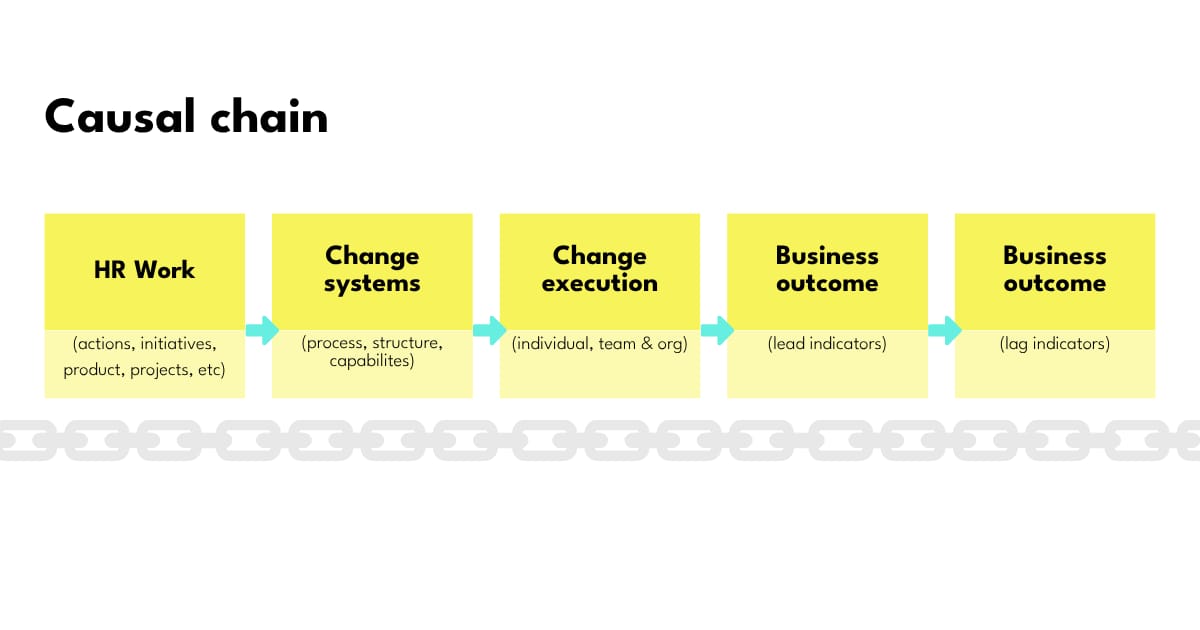
So when HR jumps straight to connecting our work directly to revenue, we skip the ENTIRE system (value chain) in between😱.
Once you understand how the business actually works (the bets it’s making and the measures it’s tracking), the question is no longer generic: "What people initiatives will increase revenue?"
It becomes far more precise: "What people conditions need to exist for these lead measures to move?"
That’s a different level of thinking. And more importantly, it’s one HR is already equipped to answer.
Make the chain visible; this is where credibility comes from
Let’s build the causal chain using the example above:
We are betting on 50% revenue growth from existing customers
➡️ that requires an upsell rate to move
➡️ but our current CS team hasn’t done this before and lacks the skills, structure or incentives to drive upsell
➡️ so HR is hiring, upskilling, restructuring and redesigning incentives to close that gap
➡️ and we will know it's working when the upsell rate moves.
That is no longer a leap of faith. That is a causal chain made visible.
If we can’t connect to the business strategy, we’re asking for a leap of faith
What I shared above isn’t about HR “getting better at storytelling,” this is about HR stepping up as a commercial leader.
If we can’t connect our work to how the business achieves its goal, we’ll always be squeezed into the last 10 minutes of the agenda in exec meetings. The people agenda should be part of every business conversation from the start, woven into every part of business discussions.
HR work enables business strategy — make the chain visible, and make our impact visible.
PS: The business example above is simplified to make the point. Your business will have its own bets and therefore its own lead measures. The key takeaway is how to look at the problem and build the causal chain.


Linking HR work to business impact is simpler than you think
A couple of weeks ago, I was coaching Sara, a Head of People, whose goal is to think more commercially.
As we started, she told me about genuinely exciting work she had been doing inside her high-growth fintech start-up. Over the past 6 months, she had led the AI transformation. She was proud of it, and rightly so! 😊
With her career goal in mind, I asked her a simple question.
"Build product, sell product, make revenue and profit. Which of the 3 has your AI transformation work impacted?"
She said: build product.
"Tell me more."
Where most HR leaders’ impact stops
She went straight to the people's side. She told me how the team worked differently. How PMs were communicating better. How agents had taken over operational tasks so people could focus on what mattered.
I stopped her✋.
"I don't want to know how the people work (yet). Tell me what changed in the business?"
Silence. Then: "I think I focus on people too much."
Sara wasn't wrong about the impact. The work was real. But for her, the people change was the end of the story (and she had stopped building there).
As I asked her questions from a business perspective, the fuller picture emerged.
The causal chain was there, just not visible
Before the transformation, each team could release one feature per quarter. Now, the product team has increased that to 2–3 features per quarter. They were releasing with more certainty too; features were landing with higher user adoption because they were building closer to real customer needs. That is a meaningful business result.
But Sara had never said it that way. Not once. Not to her founder, not to her SLT, not even to herself – until I teased it out of her.
She had the chain. She just hadn't built it. So, I replayed back to her – the whole picture, every link visible:
HR led AI transformation across teams ➡️ operational tasks shifted to agents, restructuring how PMs spent their time ➡️ PMs now focused entirely on product releases and customer contact ➡️ release cadence increased from 1 to 2–3 per quarter, with higher feature adoption ➡️ faster, more targeted product growth.
👀 When she heard it back that way, she said, "It sounds so obvious when you say it like that."
It always does. After😜.
Build the causal link to build HR’s credibility
The issue wasn’t that she was not commercial; it was where she stopped.
She stopped at ‘people.’ And when HR leaders end there, your stakeholders can't see the link between what we did and what changed in the business. At that point, we haven't shown an impact on the business. We have a story. And stories, however good, still sound like a leap of faith. So remember this:
The business will not build your causal chain for you. You have to.
Last but not least, if you can’t build that chain, you have to ask: “Should this work be done at all? Is it actually a business priority?”
Step up from HR Leader to Business Leader
Ready to influence strategically, drive business impact and make HR indispensable?
Here are 3 ways I can help:
 |  |  |

Reply